
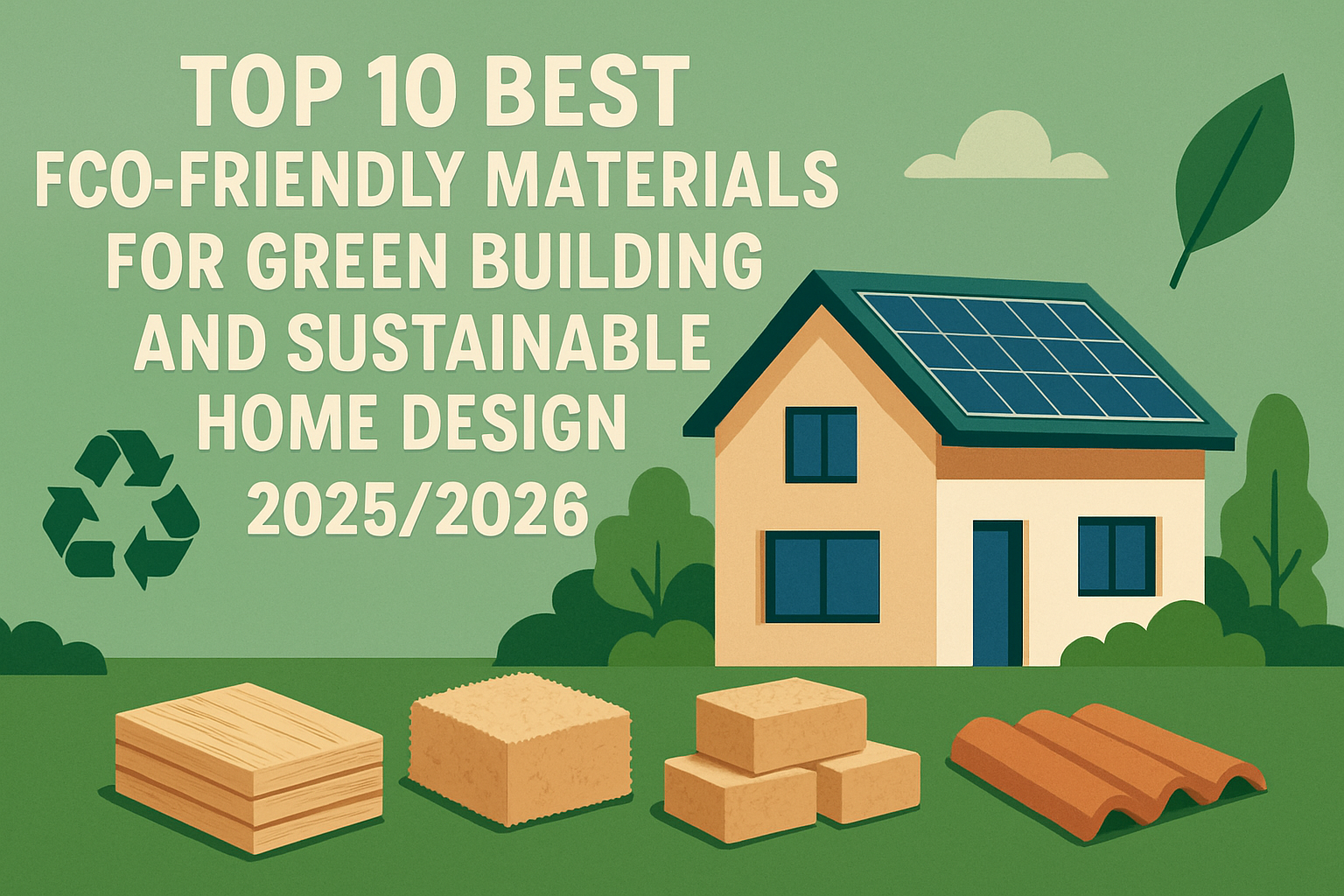
Exploring Eco-Friendly Materials in Construction
As engineers, we’re constantly being challenged to build smarter, not just in terms of cost and efficiency, but with sustainability in mind. The pressure is growing from clients, regulators, and even end users to reduce the environmental impact of what we design and construct. But let’s be honest, finding materials that are both eco-friendly and practical for real-world projects isn’t always straightforward. Between budget constraints, availability, and performance requirements, it can feel like a constant trade-off. That’s why understanding the right sustainable materials, and how they actually perform on-site, is critical. In this article, we’ll explore 10 eco-friendly building materials that strike the right balance between sustainability and functionality, helping you make informed choices that align with both your project goals and the planet’s needs.
In this article we’re going to be taking a look at some alternative yet eco-friendly materials such as seaweed, mushrooms, and even coffee and their practical applications in construction. Formerly used as wine stoppers or bulletin boards, in recent years cork has been found to be one of the most sustainable building materials in the world, with eco-minded construction companies in search of more lightweight, low-cost, sustainable, and versatile building materials that not only are aesthetically pleasing but also effectively insulate and provide long-term protection from the elements.
Cork ticks all of the boxes. Cork is harvested from a water-repellent layer of bark on the cork oak tree, mostly grown in the Mediterranean region of Southwest Europe and Northern Africa. One reason that cork is so sustainable is that no trees actually need to be cut down in order for it to be harvested, and it is easy to recycle. The trees grow for 25 years until their trunks are wide enough, and then the cork can be stripped from them every nine years. Poor cork trees can live up to 300 years, and the older the cork tree, the better quality the cork that is harvested is.
Interconnecting blocks and roof tiles made from cork can provide durability and easy assembly while also allowing the structure to blend in with its surrounding environment. These are just a few examples of how cork has been used in building homes, hotels, studios, and exhibitions around the world. Colombia is one of the world’s largest coffee producers, exporting an estimated 15 million bags of coffee beans in 2019 alone. Despite the booming business, Colombia is also unfortunately one of the world’s most economically disadvantaged countries, with around 35 percent of its population living in poverty.
Innovative Housing From Coffee Waste
This has led to many people being unable to afford housing, an issue that Bogotá-based construction company Woodpecker hopes to solve. By combining coffee husks with recycled plastic, Woodpecker has developed building blocks that link together around a steel frame to create lightweight and easy-to-install tiny homes that can serve as single-family homes or classrooms for rural or more isolated areas. The coffee husk is the skin of the coffee bean that dries and falls off during the roasting process and usually ends up in landfills afterwards. It is stronger and drier than other fibers and allows for these homes, which sell for less than five thousand dollars each, to be pest and moisture resistant.
Nearly three thousand of Woodpecker’s buildings have already been sold, and the company is working alongside the Colombian government to help house those who have been displaced due to natural disasters. For projects inside the home, Dutch designer Miki Maja and a team of five have developed a newspaper board, an original material adaptable for floorboards, hybrid furniture, shelving, concept car interiors, and more. Made from sheets of recycled newspaper glued together and layered, the pieces are then dried, compacted, sorted, and sanded, giving it the look of wood grain.
Eco-Friendly Building Materials Transforming Modern Architecture
Due to the size and strength limitations of newspaper, newspaper wood is not aiming to act as a large-scale alternative to woods, but it does offer a potential solution to the global paper waste problem. In the UK alone, it is estimated that over 6.3 trillion tons of paper are thrown away every year, whereas recycling can save millions of trees. Imagine a material with the potential to be the key to a sustainable future in the fields of fashion, art, food, shipping, construction, and more. Mycelium, or the tiny thread-like roots of mushrooms, may just be able to fill these big shoes.
It is 100 percent biodegradable and compostable, yet when dried is strong and durable enough to resist mold, water, and fire. In recent years, mycelium has been used for creating eco-conscious packaging materials, meat alternatives, and even skin care products. Now, however, mycelium compressed into bricks is one of the construction industry’s most exciting and promising new building materials. Because fungi are living, breathing organisms, they self-regenerate quickly and can assemble themselves into lightweight yet solid objects in a very short time.
Mycelium and Algae: The Future of Sustainable Structures
For more precise or complex projects like insulation, mycelium can be used in 3D printing, making it the ultimate non-toxic building material. Examples of mycelium structures include the HiFi in Queens, New York, the Growing Pavilion in the Netherlands, created to showcase how mycelium self-assembles, and the MycoTree project in Seoul, South Korea, exhibited to show how mycelium is strong enough to act as essential structure and support for buildings while also adding natural beauty to any space.
You may think of green algae as something that only grows in your local pond or river, but in Hamburg, Germany, green algae is being used to provide energy for an entire building. The photosynthesis occurring in the algae cells turns the sun’s energy into fuel for the building. The algae rapidly grows within the glass panels that cover the entire building, where it is then extracted and put into a bio-converter, which turns the algae into biomass. This biomass can then be used for a number of things including a source of food for humans or animals, and it can also power cars.
But its greatest ability is that it can generate electricity and heat for those living in the building. When we visited this project in 2019, we were told that the process was actually producing so much energy that it could also power the surrounding buildings too. You can learn more about this and other green projects in our green architecture video. Here in the UK alone, nearly three billion disposable diapers are thrown into landfill each year.
Recycling Sanitary Waste Into Building Materials
To tackle this issue, Canadian company No Waste are recycling diapers and other absorbent sanitary products into roof tiles. The recycling process sanitizes the waste to create two different materials. Firstly, they remove the organic fibers and use them for green energy and paper, while secondly, they extract the plastic binding these sanitary products to recycle into a variety of other products including plastic cladding, decking, and roof tiles. Sending these otherwise disposable products to the No Waste facility will save the same amount of space in the UK’s landfills as 96 Olympic-sized swimming pools and remove from the air the same amount of carbon dioxide as 7,500 cars.
Not to mention that once they’ve been processed, they turn into a much-needed building material. Cobb is a mixture of sandy soil, clay, and straw. It is mixed by crushing the particles together by either dancing on it or using a digger. It is an extremely cheap building method. This home, for example, was constructed for just three thousand pounds. It is one of the most eco-friendly materials of all the examples mentioned in this video, as the materials for construction can be found on the site of construction rather than needing to be imported from elsewhere.
Looking to build sustainably? Check out these top 10 sustainable building materials that are revolutionizing the construction industry. First up, bamboo. This fast-growing and renewable material is perfect for flooring, structural elements, and finishes, making it a versatile and eco-friendly choice for builders.
Recycled Steel: Strong, Sustainable, and Cost-Effective
Next, recycled steel. Highly durable and endlessly recyclable, it reduces the need for new steel production, making it a sustainable and long-lasting option for construction projects.
Recycled Glass and Reclaimed Wood in Green Architecture
Another great option is recycled glass, which is utilized in countertops, tiles, and insulation, diverting glass from landfills and giving it a new life in sustainable building projects. Reclaimed wood is also a popular choice, salvaged from old structures and used for flooring, paneling, and structural components, adding a touch of history and sustainability to any construction project.
These materials, along with others like straw bales, hempcrete, and cork, are contributing to sustainable construction by reducing resource depletion, waste generation, and carbon emissions. Make the eco-friendly choice for your next building project.
The Hidden Keys to a Sustainable Future in Construction
What if I told you that the key to a sustainable future might be hidden in unusual materials? From discarded waste to mushrooms and breathing bricks, the construction industry, one of the biggest contributors to global CO2 emissions, challenges us to rethink what we know about building. Now imagine transforming every building, whether it’s a skyscraper, a house, or a bridge, into a carbon capture device capable of reducing waste and innovating how we build. In this video, you will discover surprising solutions: bricks made from recycled plastic that are stronger than traditional concrete, concrete that consumes CO2, 3D-printed houses made from Earth, and living materials that grow on their own in just a few weeks. The best part is that these technologies are already in use and can be explored today in the Transparent Material Database, the largest repository of stable materials, ideal for architects and engineers who want to innovate. If you want to dip into the knowledge you gained from this video, follow the link in the description. It is completely free. I’m Philip Bony, founder of UGREEN, and on this channel we are driving the Green Revolution in construction.
Ready to build a future? Then hit like, subscribe, and join us on this journey. Imagine if we could turn plastic bottles, which today fill landfills and pollute the oceans, into bricks stronger than concrete. This idea, far from being science fiction, is already taking shape in innovative projects that transform what we consider trash into valuable resources for the construction industry. In scenarios where mountains of plastic are replaced by revolutionary urban works, we are invited to rethink the concept of waste, converting it into high-performance materials that can power your next project. For example, the startup Gjenge Makers, led by Nzambi Matee, converts plastic into bricks that can be up to seven times stronger than concrete, an initiative that has already recycled over 200 tons of plastic and created 600 jobs, proving that great innovations can come from simple beginnings.
Plastic Waste Innovations and Green Construction Leadership
In the United States, ByFusion developed ByBlocks, bricks made from all recyclable plastic, eliminating the need for chemical additives. In a project in Hawaii, 10 tons of waste were used to build benches and walls in just one day. Now we go to France, where FabBRICK turns two or three old t-shirts into each brick, tackling the 92 million tons of textile waste generated annually. Now we go to Canada, where CarbonCure injects CO2 directly into concrete, reducing the carbon footprint of projects by about 5%. Imagine the impact of this technique spread globally. Of course, the transformation of waste into luxury materials faces cultural, regulatory, and technical barriers, such as the possibility of plastic bricks melting above 350°C and concerns about their toxicity. The question that arises is, are governments and construction companies ready to embrace this paradigm shift?
In addition to reducing waste, these innovations bring significant social benefits, creating green jobs in underserved communities. In Kenya, for example, plastic pickers find a new source of income, while in Ethiopia, the company Kubik offers housing that is 30% more affordable by using low-carbon bricks. What do you think of this idea? Let me know in the comments. To find the next innovation, we need a telescope. Imagine a material as delicate as an atom that turns conventional concrete into a superstructure 30% stronger and with dramatically lower CO2 emissions. In an industry that consumes 1.7 tons of concrete every second, Concrene emerges as an innovative response to the climate challenge in construction.
Breakthrough Sustainable Building Materials Reshaping the Future of Construction
Although concrete is the second most used material on the planet, its environmental cost is alarming. If it were a country, it would rank among the top CO2 emitters, surpassed only by nations like China and the US. The main villain is cement, responsible for 8% of global emissions. This is where Concrene stands out, a graphene-based additive that reduces the need for cement while increasing the strength of concrete. The secret lies in graphene, discovered in 2004 at the University of Manchester. Even in minimal doses, around 0.01%, its nanoplatelets act as microscopic armor, speeding up cement hydration and forming a denser and more robust structure. The result is concrete with 30% more compressive strength, lower permeability, and a reduction of up to 20% in cement use, all without changing traditional construction equipment or techniques.
Of course, challenges remain. Graphene is naturally hydrophobic, which is similar to mixing oil and water. The Gen2 version of Concerned already overcomes this obstacle using special surfactants, but questions persist: how will this material perform over a 120-year horizon, and will the cost of graphene, currently below £50 per kilogram, allow for widespread adoption? Companies like the Spanish Graphenano, which sell similar additives in significant volumes, show that the race for sustainable concrete is indeed accelerating. Reducing concrete volume by 30% on a project is equivalent to eliminating around 4,265 kg of CO2 per project. Partnerships with giants like Cemex and significant investments around £3 million reinforce that Concrene is not just an innovation but part of an ongoing industrial revolution. Do you think it will reach your country in this decade? Tell me in the comments.
Living Building Materials and Nature-Inspired Construction
Imagine the key to reducing the carbon footprint in construction laying bricks that grow in weeks. Made from mushroom roots, mycelium, a filamentous fungal network, is becoming the secret weapon of architects against climate change. More than a material, it’s a living organism that transforms agricultural waste like straw and shells into robust, biodegradable structures capable of sequestering carbon and reducing embedded energy in buildings. The biomaterial stands out for its versatility. When it colonizes organic substrates, mycelium forms lightweight, durable blocks that can be shaped into bricks, acoustic panels, and even coat products. During growth, it stores carbon. Each kilogram of mycelium produced can capture up to 2 kg of CO2, depending on the substrate used.
Pioneering projects like Biohm already use this technology to create low-cost shelters, combining thermal efficiency with minimal environmental impact. But innovation goes beyond conventional construction. M-bricks, cured with heat, achieve resistance comparable to light concrete, while wall acoustic panels made from this material offer complete biodegradability after use, closing natural cycles. Companies like Ecovative Design explore large-scale applications from packaging to temporary structures for events, proving that it’s possible to replace plastics and synthetic foams with alternatives that breathe CO2. However, challenges persist. The durability of mycelium in humid or exposed environments still limits its use in permanent structures, requiring complementary treatments. Additionally, the lack of industrial regulatory standardization makes mass adoption difficult, especially in countries where building codes have yet to embrace living materials.
Even so, initiatives like the Living Materials Laboratory are testing hybrid mycelium compounds with natural fibers to increase strength and applications. The social implications are profound. Mycelium democratizes material production. Communities can grow their own bricks with local waste, reducing cost and waste. Affordable housing projects like those from MycoWorks illustrate how this technology can combine sustainability with inclusion, turning agro-industrial by-products into dignified housing. Mycelium proves that innovation can be alive. Would you use mycelium in your home?
Retaining heat for longer, making it perfect for environments like home offices, especially in the post-pandemic scenario. Now let me clear a question up. So is construction made from marijuana? Not exactly. Hemp and marijuana are from the same plant, Cannabis sativa, but differ in their purposes and cultivation characteristics. Marijuana is grown to maximize flower production, reaching the psychoactive compound, while hemp is grown for industrial and food purposes, containing extremely low levels of THC. So the difference lies in how they are cultivated and genetically selected.
Hempcrete and Structural Support Challenges
Just to be clear, despite the benefits, challenges remain. The drying of hempcrete can vary from 6 weeks to 6 months, and it requires structural supports such as wood or steel for heavy loads. Although lime production generates emissions, the final balance of this material is carbon negative.
Global Impact and Carbon Savings
Socially, hempcrete is already showing its impact. In Belgium, the company ISO Hemp manufactures about 1 million blocks per year, saving 18,000 tons of CO2. That’s equivalent to a car completing 32,000 trips around the globe. In the UK, 400 homes already used this material, while community projects transform old housing into more efficient homes.
Would you use this green brick in your project? As we can see, the future of construction may be linked to technologies that not only rethink traditional methods but also pave the way for a future with fewer emissions and more environmental responsibility. Would you use any of these innovations? Let us know in the comments. And thank you for watching. If you like this video, also check this out, our video with an innovation that I’m sure you will love.
In wrapping this up, I believe the most important takeaway for engineers, especially those of us who care about design, longevity, and sustainability, is that eco-friendly materials like cob and plastic bricks aren’t just alternatives; they’re long-term solutions to systemic challenges in construction. Whether you’re tackling waste reduction, cost-efficiency, or climate resilience, these materials meet real needs in both form and function. Nzambi Matee’s work in Nairobi is proof that engineering innovation doesn’t always start in a lab, it starts by responding to urgent local problems with practical, scalable solutions. As engineers, we’re not just builders, we’re problem solvers, and the materials we choose matter more now than ever.