
In the ever-evolving world of architecture and construction, few developments have transformed the industry as profoundly as Building Information Modeling, or BIM. For decades, architects and engineers relied heavily on blueprints and static plans, often juggling multiple platforms, communication breakdowns, and costly errors. Today, BIM has emerged as a silent but powerful revolution, a digital heartbeat that pulses through every stage of a building’s life, from design to demolition.
BIM is not just a tool or a trend; it is a shift in how we visualize, communicate, and coordinate. It provides a deeply detailed digital representation of the physical and functional aspects of a project. Imagine being able to walk through a building virtually, months before the first brick is laid. Now, think of the power that gives you to identify issues, streamline schedules, and align teams. That is the promise of BIM, a living model that speaks to architects, engineers, and construction managers in the language of data, clarity, and precision.
But as advanced and impressive as BIM may be, it exists within an industry where human interaction, trust, contracts, and conflict resolution are still the bedrock of success. A beautifully modeled project can still go off track when contracts fall short, responsibilities become unclear, or disputes escalate. That is why it is critical, now more than ever, for construction professionals to not only embrace digital tools but also master the very human art of navigating contracts and resolving disputes.
This article takes you deep into that human side of the industry. Whether you are a project manager, contractor, architect, or stakeholder, you will walk away with grounded insights and emotionally intelligent strategies for dealing with contract negotiation, scope gaps, dispute resolution, and legal complexities, all through the lens of real-world practice.
Why Construction Disputes Happen: A Reality Every Professional Faces
Construction is never simple. Behind the scenes of every skyline-defining skyscraper or neighborhood-defining renovation lies a maze of schedules, scope documents, budgets, subcontractors, material orders, and more. At any point in this intricate process, misunderstandings can arise. Timelines get disrupted. Weather causes delays. Scope responsibilities fall through the cracks. And when they do, the finger-pointing begins.
But these disputes are rarely just about the contract language. Often, they stem from something deeper, unclear communication, assumptions, or mismatched expectations. It is not uncommon for a contractor to assume that certain tasks are the responsibility of a subcontractor, only to discover late in the project that no one officially owns it. This is what professionals refer to as a scope gap, and it is one of the most common triggers of construction disputes.
If not caught early, scope gaps become financial burdens and breeding grounds for conflict. That is why successful project leaders make it a habit to comb through every contract document, every plan, and every exhibit with a fine-toothed comb. They do not just skim; they dig. They clarify. They ask tough questions. They go back to their teams, seeking to eliminate all ambiguity before the project moves from the page to the ground.
The Silent Cost of Miscommunication in Construction Projects
Imagine two seasoned professionals, a site engineer and a project manager — both deeply committed to their work, both wanting the best for the client, and both interpreting the same contract clause in slightly different ways. That small gap in understanding, left unresolved, might lead to days of halted work, legal involvement, and irreparable professional tension.
Miscommunication in construction is not a minor issue; it is an invisible drain on time, money, and relationships. In an industry where collaboration is everything, clarity is the currency of trust. And trust is what keeps projects moving forward.
This is where human-centered conflict resolution comes into play. The best construction professionals do not just send passive-aggressive emails and walk away. They pick up the phone. They walk across the site. They invite the other party for a coffee and hash things out in person. Because they understand something that technology alone can never replace — the value of real human connection in resolving complex problems.
Understanding Dispute Resolution: Mediation, Arbitration, and Litigation
Every seasoned construction professional knows that no matter how thorough the planning, disputes can and do occur. When they do, knowing your options can make all the difference between a painful lawsuit and a respectful compromise.
The three main methods of resolving construction disputes are mediation, arbitration, and litigation. Each method carries its own benefits and drawbacks, and the right choice often depends on the relationship between parties, the scope of the issue, and the urgency of resolution.
Mediation is often the most human-centered of the three. It involves a neutral third party — not a judge, but a facilitator, who helps both sides explore mutually acceptable solutions. The beauty of mediation lies in its informality and flexibility. There are no courtrooms, no formal statements, and no winners or losers. Just two parties seeking common ground with the help of someone impartial. It works best when both parties still care about preserving the relationship.
Arbitration, on the other hand, is more structured. It is binding, which means the decision of the arbitrator must be respected. Yet it remains more efficient than litigation. Most arbitrators are experts in construction, which means they understand industry terms, common challenges, and practical solutions. That shared understanding often results in faster, more practical outcomes.
Litigation is the last resort. It is public, expensive, time-consuming, and often emotionally draining. It may be necessary in cases where no compromise is possible, but it is rarely the first choice for professionals who value efficiency and discretion. The truth is, most construction disputes, over 90 percent, never reach court. They are resolved beforehand through informal negotiations, mediation, or arbitration.
Avoiding Scope Gaps Before They Derail Your Project
If you have ever been on a project where someone suddenly says, “Wait, I thought you were handling that,” you already understand the danger of scope gaps.
Scope gaps occur when tasks or responsibilities are not clearly assigned in the contract documents. These ambiguities often surface halfway through a build, sometimes even near completion. Suddenly, someone has to step up and perform work that was never priced, planned, or scheduled. It becomes a financial loss and a credibility issue.
To avoid this, project managers must go beyond the basics. They must not only review drawings and specs but also analyze overlaps, gray areas, and coordination points. They ask, “What happens if this piece is late? Who owns it? How does it affect the next phase?” This mindset separates proactive leaders from reactive ones.
Scope clarity should be discussed early, documented often, and updated as the project evolves. Successful firms even conduct internal “scope check workshops” with their teams to simulate possible issues and identify any overlooked responsibilities.
The Contract Negotiation Table: Where Projects Are Won or Lost
Behind every successful project is a strong contract. But many contractors make the mistake of using old templates, thinking, “This worked last time.” Unfortunately, what worked on a warehouse in 2018 might not suit a high-rise in 2025. Contracts must reflect the unique conditions, players, and risks of each project.
One common mistake is overloading subcontractors with risk. Contracts filled with clauses like “no damages for delay” or “you’re responsible for everything” may protect the primary contractor, but at a cost. Subcontractors may raise their prices to compensate for the added risk. Worse, they may walk away, leaving the main contractor scrambling. Long-term relationships are built on fairness, not force.
Clear, tailored contracts, reviewed by legal experts and written in plain, understandable language, go a long way. Add to this the importance of documentation. Every decision, every change, every concern should be recorded. Not just in voice notes or texts, but in emails and formal records that can be referenced later. It is not about covering your back; it is about creating a transparent trail that keeps everyone accountable.
Contracting in a Post-Pandemic World: What Changed and What’s Here to Stay
The COVID-19 pandemic turned the construction industry upside down. Projects halted. Material prices skyrocketed. Supply chains broke down. The chaos exposed weaknesses in many contracts, particularly those that lacked escalation clauses or provisions for force majeure.
Now, forward-thinking contractors include clauses that allow for adjustments if material costs rise unpredictably or if supply chains collapse. This flexibility is no longer a luxury — it is essential. Everyone in the chain, from client to supplier, must acknowledge that some disruptions are beyond control. Contracts must reflect this shared understanding.
The lesson is clear. Rigid contracts may seem strong on paper, but flexible contracts are what keep projects moving when the world shifts unexpectedly.
Public vs Private Construction Projects: A Legal Landscape Split in Two
Navigating legal issues in construction is tricky enough, but it becomes even more complex when working with government entities. Public projects follow stricter timelines, documentation standards, and decision-making processes. Disputes can drag on for months, sometimes years, because of bureaucratic red tape.
Private projects, on the other hand, tend to move faster. The stakeholders often have more autonomy and a stronger incentive to preserve working relationships. Disputes can be settled over a series of phone calls or meetings, particularly if both parties anticipate future collaborations.
Understanding the difference between these environments helps contractors adjust their communication strategies, negotiation styles, and expectations.
How to Prevent and Resolve Disputes Like a Seasoned Pro
The best project managers and contractors know that conflict is not always a sign of failure. Sometimes, it is just a natural part of collaboration. But how you respond makes all the difference.
Rather than letting small issues fester, seasoned professionals address them early. They avoid blaming language and stick to the facts. They separate the people from the problem, focusing on solutions, not personalities.
When conflicts escalate, they do not rely solely on emails. They meet in person. They listen actively. They stay calm. They seek understanding before pushing their point. These soft skills, often undervalued, are what turn potential disasters into manageable disagreements.
And when all else fails, they know when to bring in outside help, a mediator, an arbitrator, or legal counsel. They do so not out of weakness but out of a commitment to resolution.
The Human Side of Contracts and Construction
In a world where construction is increasingly driven by data, software, and digital models, the human touch remains irreplaceable. BIM can help you plan better. Contracts can help you manage risk. But it is human judgment, empathy, communication, and trust that ultimately determine whether a project thrives or falls apart.
The best construction professionals do not just build structures, they build relationships. They know the value of a clear word, a firm handshake, a documented email, and a fair agreement. They understand that every clause, every scope exhibit, and every dispute is not just legal language but a reflection of people working together toward a shared goal.
In this balance between technology and humanity, between data and dialogue, lies the true art of managing construction contracts and resolving disputes.
And that is where the future of the industry will be written, not just in the pixels of a BIM model, but in the choices professionals make every day to lead with clarity, integrity, and care.
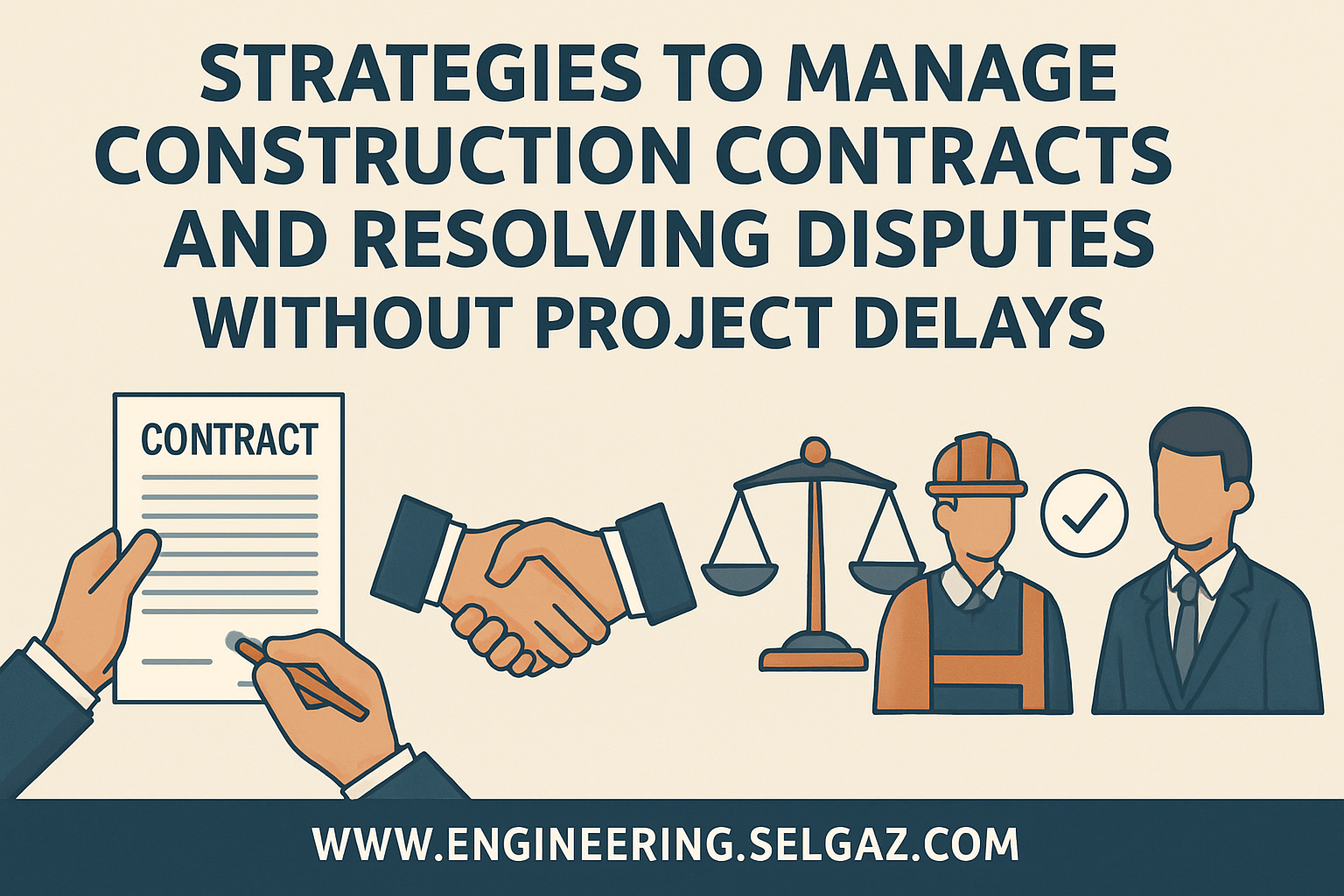
Managing construction contracts isn’t just about signing papers, it’s about actively reducing risk, protecting your timelines, and preserving relationships on site. Every engineer who’s spent time on a project knows how fast a small misunderstanding can snowball into costly delays. That’s why clear communication, well-defined scopes, regular documentation, and proactive stakeholder engagement aren’t just best practices, they’re your insurance against disputes. And when conflict does arise, as it inevitably will, it’s not about who’s right, but how fast and fairly you can resolve it without letting the work stall. Engineers who stay sharp on contract strategy and dispute resolution tools not only keep projects moving, they build reputations as reliable problem-solvers who know how to deliver under pressure. In the end, the goal isn’t just finishing, it’s finishing strong, with minimal friction and maximum value.